



HKICPA submits proposals for the Government budget under four main themes to reinforce Hong Kong’s strengths, innovation and talent for a bright and bold future
Today, the Hong Kong Institute of Certified Public Accountants (HKICPA) announces its proposals for the Government’s budget for the 2026-27 fiscal year under the theme “Reinforcing and enhancing Hong Kong’s strengths, innovation and talent for a bright and bold future”. The HKICPA’s budget proposals include a wide range of measures under four main themes, covering:
(I) Attracting investment and promoting economic growth
(II) Attracting, retaining and nurturing talent
(III) Ensuring resilient and sustainable public finances and a competitive tax system
(IV) Supporting the community and sustainable development
The HKICPA estimates that the budget deficit for 2025-26 will be approximately HK$1.4 billion, primarily attributable to ongoing spending on essential major infrastructure. It is expected that there will be an operating account surplus driven by the rebound in stock market-related stamp duty revenue in this fiscal year. The HKICPA anticipates the fiscal reserves will stand at approximately HK$652.9 billion by the end of March 2026, representing around 10 months of Government expenditure.
While this is on the low side, based on the government’s past benchmarks, the HKICPA’s view is that, given Hong Kong’s overall financial strength, with over HK$4 trillion of assets in the Exchange Fund managed by the Hong Kong Monetary Authority (which also includes the fiscal reserves), and a deficit-to-GDP ratio of around 4.8%, Hong Kong’s current financial position remains sound. The debt-to-GDP ratio was estimated be around 9% in 2024 and, according to the Government, is projected to remain at a prudent and manageable level of between 12% to 16.5% through to 2029-30, which is much lower than most of the advanced economies. With the Government’s revised real GDP growth forecast of 3.2% for 2025 and a modest inflation rate, there is no immediate cause for concern. Nevertheless, structural factors contributing to the deficit, such as increased welfare and healthcare spending, resulting from an ageing population, and reliance on land-based revenue, highlight the need for proactive fiscal policy adjustments to ensure long-term sustainability.
Stephen Law, President of HKICPA said: “Hong Kong’s economy has remained resilient amid global uncertainties, supported by steady growth in exports, improving domestic demand, and a strong capital market performance. In addition, our debt-to-GDP ratio is low compared with most developed countries. At the same time, the territory is facing some structural challenges, ranging from an ageing population and continuing talent gaps to fiscal pressures and shifting consumption patterns. These underscore the need for long‑term competitiveness and sustainable growth. With prudent fiscal management, targeted tax and policy reforms, and continued investment in innovation, talent development and sustainability, we believe that Hong Kong can reinforce its position as a leading international financial centre, as well as a logistics, innovation and technology, and education hub. The HKICPA’s 2026–27 budget proposals aim to support this trajectory by strengthening our competitiveness and fostering a vibrant, future‑ready economy.”
(I) Attracting investment and promoting economic growth
Strengthening the Regional Headquarters Economy
To reinforce Hong Kong’s status as a leading international business hub, the HKICPA proposes targeted incentives to attract Regional Headquarters (RHQs). This includes offering a half-rate profits tax concession (8.25%) for relevant profits derived by qualifying RHQs for a fixed period of five years. To support Chinese Mainland enterprises and, potentially, other regional companies, using Hong Kong as a base to “go global,” the Institute suggests providing an additional two-year tax exemption for such enterprises that set up qualifying RHQs in Hong Kong, alongside rental subsidies and special visa arrangements for C-suite executives. The HKICPA also recommends introducing a “2+3” years’ work visa arrangement for these executives and ensuring clarity in their tax positions to encourage long-term commitments.
Boosting Innovation and Supporting SMEs
For the innovation sector, the HKICPA recommends a holistic review of tax incentives for research and development (R&D) and intellectual property (IP), with a view to relaxing some anti-avoidance provisions under the IP deduction rules and allowing deductions for outsourced R&D activities in the Greater Bay Area. Furthermore, the HKICPA proposes establishing a dedicated funding scheme and providing technical support to accelerate the development of quantum computing, and attracting leading quantum computing enterprises through financial incentives and tax concessions. To support Small and Medium-sized Enterprises (SMEs) during the economic transition, the HKICPA proposes adjusting the two-tier profits tax regime by adjusting the rate downwards or raising the threshold of HK$2 million to HK$3 million for standalone SMEs, and providing a time-limited subsidy or tax super-deduction for SMEs to hire IT specialists to help their digital transformation.
Invigorating Capital Markets and Enhancing Family Office Advantages
To further enrich the local asset management and trading ecosystem, the HKICPA suggests refining the tax concession regime for single family offices. This includes determining the HK$240 million minimum asset threshold based on “Assets Under Management” (AUM), and expanding the scope of tax exemptions to include assets such as artworks, which would align with the vision set out in the 2025 Policy Address to develop Hong Kong as a premier arts trading hub. Additionally, the HKICPA encourages the launch of more innovative RMB-denominated offshore products, such as annuities, insurance, and financial instruments; and exploring with Chinese Mainland authorities the feasibility of an “IPO Connect” pilot scheme to allow Chinese Mainland institutional investors to subscribe for Hong Kong initial public offerings. The HKICPA also recommends measures to incentivise spending on smart ports and logistics, and tax concessions for commodity-trading related logistics, in addition to a stamp duty exemption for Hong Kong-incorporated private companies on intra-group asset transfers, to reduce corporate restructuring costs and encourage further re-domiciliations.
Strengthening Hong Kong’s Branding and Support during Economic Restructuring
The HKICPA proposes promoting “Brand Hong Kong”, leveraging on the city’s reputation for quality and reliability, and also championing the multifaceted, multicultural, unique Hong Kong community. Meanwhile, to help businesses affected by the ongoing economic restructuring, the HKICPA recommends establishing an expert group to advise on the challenges and opportunities of the rapidly-evolving cross-boundary economy.
Eugene Yeung, Chair of HKICPA’s Taxation Faculty Executive Committee, explains: “Hong Kong must stay competitive in a fast‑changing global economy. Therefore, the HKICPA proposes tax and non-tax measures to attract more regional headquarters and family offices, and investment in R&D and the use and creation of intellectual property. These are sectors that can drive sustainable growth, provide new opportunities and reinforce Hong Kong’s long‑term economic vitality. Meanwhile, we also propose promoting some of the unique qualities and strengths of our community that have made Hong Kong what is it is today and continue to make it attractive to people from all over the world.”
(II) Attracting, retaining and nurturing talent
Optimizing Talent Strategies
While the Government’s talent admission schemes have been pretty successful so far, the HKICPA suggests refining them to align with long-term workforce demands, as well as ensuring that applicants settle in Hong Kong to contribute to the economy and the community. Other recommendations include simplifying visa procedures and establishing a green channel for GBA and overseas students to undertake professional sector internships in Hong Kong during peak seasons; and subsidizing employers to provide competitive salaries and accommodation to help retain high-calibre graduates. The HKICPA also proposes providing a private education allowances for children of overseas talent, and launching a “Property Connect” pilot scheme to allow recently-arrived Chinese Mainland talent to purchase first-hand residential properties in Hong Kong directly using RMB.
Driving Population Growth and unleashing the Silver Economy
To encourage childbirth and support working families, the HKICPA proposes extending statutory maternity leave to 16 weeks and paternity leave to 10 days, with Government subsidies for the additional wages. To tap into the "silver economy" and address the shrinking workforce, among other measures, the HKICPA recommends increasing the basic allowances for retired individuals aged 65 and above who re-enter the workforce, and providing enhanced tax deductions of 125% on their salaries, for employers, for up to two years.
(III) Ensuring resilient and sustainable public finances and a competitive tax system
Broadening the Revenue Base and Affordable Users pay
To ensure sustainable public finances, the HKICPA calls for a review of Hong Kong’s tax base against long-term spending needs and the exploration of broader-based taxes to stabilize revenues and avoid over-reliance on volatile revenue sources. In the short term, the HKICPA suggests specific measures to increase revenue in accordance with the “affordable users pay” principle. These include increasing the stamp duty on leases of residential properties, which has not been revised for many years, and increasing the higher-tier standard rate for salaries tax from 16% to 16.5%, or lowering the threshold at which this rate is applied, to income over HK$4 million. The HKICPA also suggests introducing a boundary facilities fee for private vehicles entering control points to help fund the cost of facilities and infrastructure maintenance at various control points.
Enhancing Tax Efficiency and Compliance
To improve tax compliance, the HKICPA proposes a limited-time, voluntary self-reporting scheme for small-scale and online businesses, such as online store owners and key opinion leaders (KOLs), coupled with a waiver of penalties to encourage tax compliance.
Agnes Cheung, Convenor of HKICPA’s Budget Proposals Task Force, added: “Ensuring sustainable public finances while maintaining a competitive tax system is vital to Hong Kong’s long‑term stability and growth. The HKICPA’s proposals — from broadening the tax base to strengthening fiscal discipline and enhancing tax certainty — are practical steps that help reinforce investor confidence and support a resilient economic future.”
(IV) Supporting the community and sustainable development
Alleviating Community Burdens
To alleviate the financial burden on residents, the HKICPA suggests a one-off tax reduction of 100% on salaries and profits tax for 2025-26, subject to a ceiling of HK$5,000 and/or an increase in personal allowances. The HKICPA also proposes a rates concession for properties owned by natural persons for two quarters, capped at HK$1,200 per quarter, targeting properties with lower rateable values. To support the property market and homeowners, the HKICPA suggests allowing purchasers of residential property for self-use to pay stamp duty in equal annual instalments over three years. In addition, the Institute suggests extending the rental deduction under salaries to include rental of serviced apartments, given that non-Hong Kong people working in Hong Kong may reside in serviced apartments for extended periods and may not receive a housing subsidy from their employers.
Regarding citizens affected by the Wang Fuk Court fire tragedy, the HKICPA endorses the Government’s decision to provide them with full tax waivers and treat relevant financial donations towards those affected as approved charitable donations.
Driving Green Transition
On sustainable development, the HKICPA recommends extending the ‘EV-charging at Home Subsidy Scheme’ to promote green transport, and continuing support for new energy transport schemes. In addition, the Government should mandate minimum energy-efficiency standards in new buildings and factor in Hong Kong’s carbon neutrality target in key aspects of major new infrastructure projects, which should also provide more opportunities for Hong Kong’s active green bond market. To further support businesses in achieving carbon neutrality, the HKICPA proposes as an interim measure, allowing tax deductions for expenses incurred on purchasing certified renewable energy and carbon credits, to support the “Core Climate” market and, as a transitional measure, to enable companies to reduce their carbon footprint.
On tourism, the HKICPA proposes promoting more high-end and well-managed eco-tourism, and collaborating with Greater Bay Area cities to develop combined tourism packages, highlighting the unique cultural and ecological experiences of each city.
To download the full budget proposal “Reinforcing and enhancing Hong Kong’s strengths, innovation and talent for a bright and bold future”, please scan:

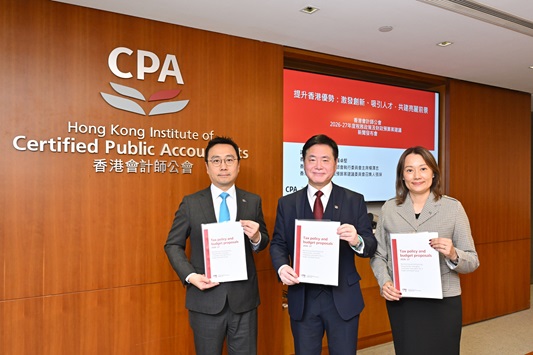
Stephen Law, President of the HKICPA (Centre), Eugene Yeung, Chair of Taxation Faculty Executive Committee of HKICPA (Left) and Agnes Cheung, Convenor of Budget Proposals Task Force of HKICPA (Right) presented the HKICPA’s 2026-27 Budget Proposals “Reinforcing and enhancing Hong Kong’s strengths, innovation and talent for a bright and bold future”, which includes a range of recommendations under four key themes.
