


A spotlight on systems
From audit to advisory, Amelia Zhu’s career has been all about getting closer to the business action
Understanding organizations
Given her academic background in Global China Studies and Marine Science, accountancy wasn’t necessarily the obvious career choice for Amelia Zhu. Now a Senior Associate at consulting firm EY-Parthenon, Amelia Zhu, originally from Jiangxi province, first came to Hong Kong to study at the Hong Kong University of Science and Technology. Through a joint 3+1 programme with Shantou University, she completed the final year of her undergraduate studies at HKUST while also beginning her master’s studies there, earning both a bachelor’s and a master’s degree.
“My academic career may seem very unconventional, but there has always been a common thread,” she says. “Every stage of my journey, from Marine Science to accountancy and transaction advisory, has been driven by the same curiosity: understanding how systems work and how people make decisions within them.
“Marine Science taught me how to think scientifically. My master’s degree taught me about global social, political and economic systems. Before I entered the workplace, I thought the one missing piece was the business world. What attracted me wasn’t accountancy but what accountancy represents – it’s the language of business. It provides a structured way to understand how organizations operate, how decisions are made, and how value is created.”
She began her career, as many graduates do, working as an auditor at a Big Four firm, in her case KPMG, where her clients included leading giants in the aviation, consumer products and other sectors. She says it was hard but rewarding work.
“It was where my transition from student to working professional was completed. KPMG completely changed my view of how organizations work. The most important lesson I learned wasn’t a technical accounting one; it was learning to take ownership. Professional success comes from the ability to deliver high-quality work under uncertainty.”
She notes that she also developed analytical skills that continue to be useful to this day: approaching problems in a structured way and paying attention to detail while dealing with large volumes of information. But perhaps the most important lesson she learned, she adds, was to let go of her perfectionism.
“I wanted everything to be perfect, but I had a mentor early in my career who told me that in professional services, sometimes it isn’t about perfection; it’s about the 80 per cent that really drives value and decision-making, rather than spending disproportionate effort on incremental improvements. As a student, I was trained to pursue the perfect answer. As a professional, I learned that success is often about delivering the right answer at the right time. I learned to become comfortable with ambiguity. I needed to exercise judgement and determine the next step myself.”
She says that she particularly enjoyed working with large companies, which allowed her to get exposure to how they actually work in practice. “It fascinated me, seeing how businesses make decisions, respond to challenges and create value. It was highly relevant to my current job – the story behind the numbers is just as important as the numbers.”
While working at KPMG, she studied for QP, taking her first exam in 2023 and completing the course in 2025. She was one of the outstanding students among her intake, scooping the Capstone Silver Prize (BDO Prize).
“Coming from a non-accounting background, I viewed QP as a structured way to gain professional competence,” she says. “It strengthened both my technical skills and my professional judgement. It boosted by confidence – it gave me the credibility to trust my own decisions. As a non-accounting graduate, I had inner doubts; I think that’s normal.”
As with many QP students, she also found the course’s real-world applicability particularly refreshing. “I feel like QP is very different from a lot of exams I’ve taken. Real-world questions do not have a single correct answer, and the same is true in QP; there’s a lot of room to provide your own answer.”
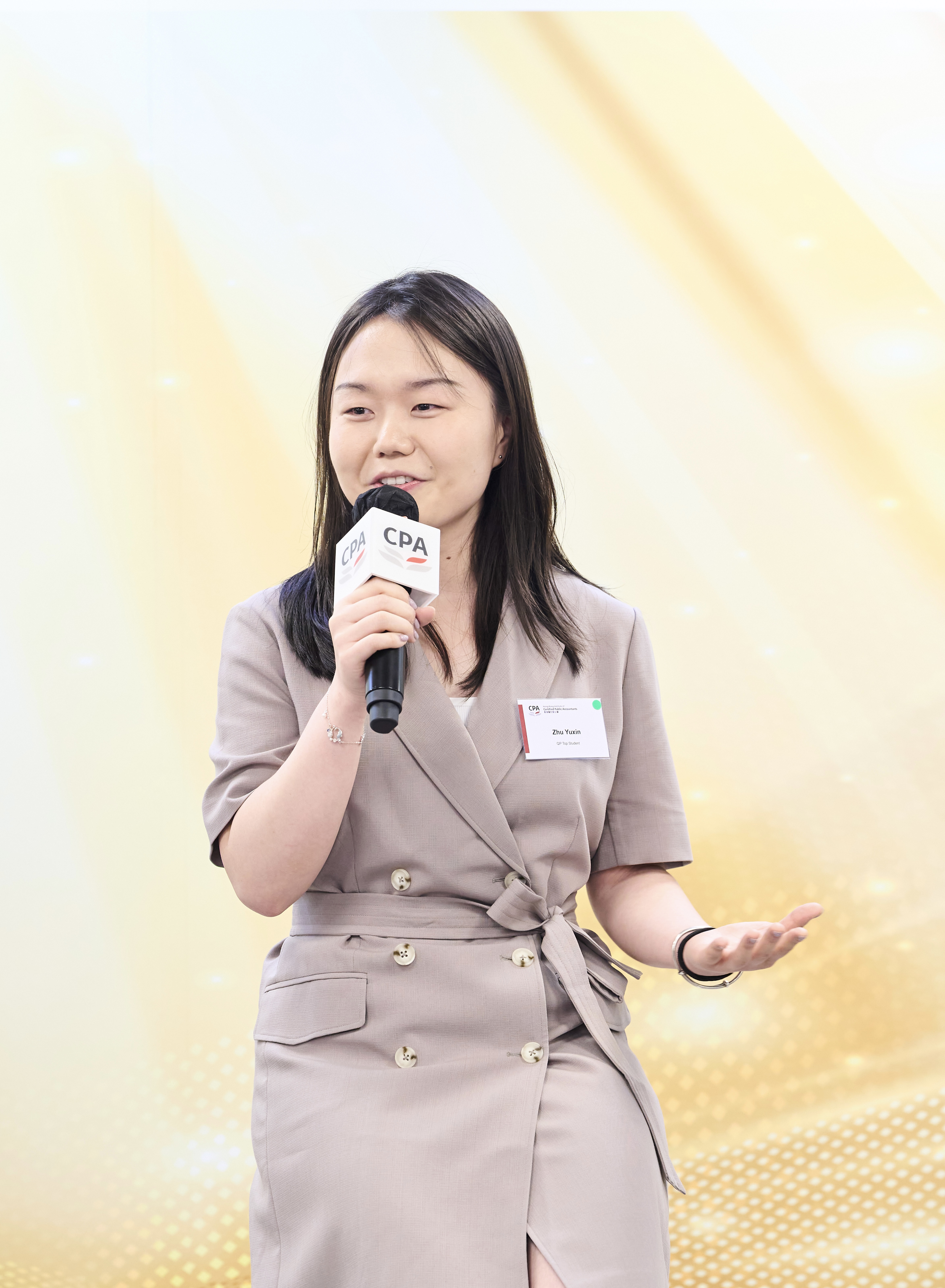

Ms. Amelia Zhu
Strategic satisfaction
After just over three years as an auditor at KPMG, it was time for a move – to consulting firm EY-Parthenon, where she started in December 2025. She specializes in mergers and acquisitions, providing due diligence in industries including technology and healthcare.
“What attracted me to EY-Parthenon was the opportunity to work closer to strategic decision-making. In audit, you need to understand what happens. In advisory, you need to understand why it happens,” she says, adding that she’s particularly drawn to the fast-paced nature of due diligence and the opportunity it provides to work across different industries.
“Many skills from my audit background are very transferrable: attention to detail, professional scepticism, the ability to analyse large amounts of data and communication skills. But it’s also been a steep learning curve, learning how to think more commercially rather than just focusing on financial statement accuracy, and translating data into actionable intelligence. It requires a broader understanding of how businesses create value.”
In her spare time, Amelia is also a keen linguist who has taken the time to learn languages as diverse as Korean and Hebrew – even travelling to Israel’s University of Haifa to acquire the latter – as well as working as a research assistant at HKUST’s Centre for Chinese Linguistics while she was a student. While these skills haven’t been of direct professional use, she says, learning new languages has been rewarding for her at a far deeper level.
“It’s not just about a professional tool but access to a culture and a way of looking at the world. It has helped me develop cultural awareness, adaptability and communication skills. I’m also more confident dealing with people in professional contexts.”
