


HKICPA “Teen Money Survey 2025” grades students’ financial management skills “B-“ ; Urges awareness of fraud risks
The Hong Kong Institute of Certified Public Accountants (HKICPA) published the "Teen Money Management Survey 2025", assigning Hong Kong’s primary and secondary school students a "B-" for financial literacy. The findings show that students generally possess basic financial knowledge and correct spending attitudes. However, nearly 10% of the surveyed students reported experiencing fraud and financial losses, indicating an urgent need for heightened cybersecurity awareness and fraud prevention in an increasingly digital world. The HKICPA calls for greater community attention to these issues.
Solid foundation with improved spending tracking habits
Conducted from May to June this year, the online survey collected response from over 2,000 primary four to secondary three students, to understand their spending and financial management habits. Results indicate that 87.4% of students have savings habits, consistent with the survey conducted two years ago (2023), while half (50.4%) now regularly track their income and expenses, a significant 15 % rise from the maiden survey (2020), reflecting the continuous improvement in students' basic financial literacy. Notably, more students use digital tools (such as mobile applications or spreadsheets) than traditional paper-based methods, with over a quarter adopting technology, indicating that digitalization helps the youth practise financial management.
Pocket Money, Digital Payments, and Rising Allowances
Among those receiving pocket money, one-third stated that they did not receive it regularly. The HKICPA believes that inconsistent allowances disbursements may impact students' ability to develop disciplined financial management. While cash remains the main medium for pocket money, there is steady growth in the use of cashless methods (such as Octopus, bank transfers, e-payment platforms), reflecting the growing popularity of cashless transactions. Average weekly pocket money has risen to HK$93.8 for primary students and HK$320.9 for secondary students, both notable increases from two years prior, exceeding inflation and reflecting parental response to rising basic expenses such as food and transportation.
Borrowing and Lending: A Common Occurrence
In addition to students' income and financial planning, the Survey also tracks students' borrowing behaviours. More than 40% (43.8%) of students stated that they have borrowed money, while 67% have lent money, mainly to friends or schoolmates. The result reflects that lending and borrowing are common among peers. Although borrowing typically relates to unexpected situations like forgotten wallets, approximately 30% borrowed for entertainment, revealing room for improvement in budget management and spending discipline. HKICPA advises students to plan their expenses carefully to avoid borrowing for non-essential or additional expenditures.
Financial education should evolve with time
HKICPA President Edward Au said, “The HKICPA remains committed to youth financial education and advocated for continuous policy improvements through various initiatives such as the flagship 'Rich Kid, Poor Kid' programme. While pleased with students’ solid financial foundations, we emphasize, in the face of digital change, that families, schools, and society must work together to foster sophisticated financial mindsets and fraud awareness among students to cope with the challenges of the digital economy era.”
Students vulnerable to fraud, losses reach HK$10,000
In response to the increasing prevalence of online consumption and technology scams in recent years, this year’s survey included a dedicated section to understand students' awareness of cybersecurity and fraud prevention. Students rated their anti-fraud capabilities highly (average 4.1/5). However, over 190 students (equivalent to nearly 10%) reported financial losses due to fraud—averaging HK$1,100 and up to HK$10,000— mainly from "investment or goods resale promising 'zero risk, high return'", "game credit trading", "online shopping", and "account hijacking".
This gap between perceived and actual risk underscores students’ underestimation of risks and the need for stronger fraud prevention education, as students are often lured by quick gains. The HKICPA believes that there is an urgent need to strengthen students' awareness to prevent from financial fraud.
On the other hand, the Survey also assessed students' cybersecurity awareness by understanding their online account management habits. Among students with experiences in managing online accounts, over 60% indicated that they set passwords with a combination of uppercase and lowercase English letters, numbers, and special characters. However, nearly 40% stated that they use the same password across multiple platforms, and over half have never changed their passwords, reflecting an insufficient awareness of online account security. To this end, the HKICPA recommends students change their online account passwords every 3 to 6 months and use a combination with security strength, such as a password of more than 12 characters combining letters, numbers and symbols, to enhance account security.
Edward Au added: "We hope that the results and analysis of the survey will provide practical reference for stakeholders such as students and parents and help the Institute offer appropriate advice on financial education. We firmly believe that equipping the new generation with sound financial knowledge and skills lays a foundation for Hong Kong's future development. The Institute will continue to work hand-in-hand with members and stakeholders, giving back to society through professionalism and nurturing a new generation of financially savvy individuals."
HKICPA’s four key recommendations
Based on the findings of the "Teen Money Management Survey", the HKICPA puts forward the following four recommendations, hoping to collaborate with stakeholders from various sectors to continuously enhance financial education in Hong Kong.
1. Integrate financial education with life planning
Blending financial education into life planning, guiding students to set personal short to medium to long-term goals, and enabling students linking financial planning to life values.
2. Strengthen students' awareness of cybersecurity and fraud prevention
In light of the digitalization trend, all sectors should enhance students' awareness of cybersecurity and fraud prevention. It is recommended that schools incorporate financial education elements into the existing "Information Literacy and E-Safety" learning framework, covering password management strategies, fraud message identification skills, and knowledge of secure payment.
3. Enhance financial accountability and risk identification capabilities
Through further training in budget planning, enhance students' awareness of financial accountability and their ability to assess borrowing and lending risks, cultivating the mindset of "preparing for a rainy day".
4. Enhance support for "Home-school cooperation"
Parents and schools remain the primary channels for students to acquire financial literacy. Their cooperation provides "dual-track support" for students, fostering application of financial education in daily life and learning.
The HKICPA has been a long-standing advocate in promoting the financial education in Hong Kong. We also encourage members to leverage their professional expertise to give back to society. Over the past 20 years, the flagship "Rich Kid, Poor Kid" financial education programme has benefited nearly 200,000 primary and secondary school students, becoming a vital pillar of financial education for young generations in Hong Kong. Looking ahead, the HKICPA will continue to connect various sectors to continuously enhance financial education in Hong Kong and nurture new generations of financially smart individuals.
For full report of the HKICPA “Teen Money Management Survey 2025” (Chinese only), please scan the QR code below:

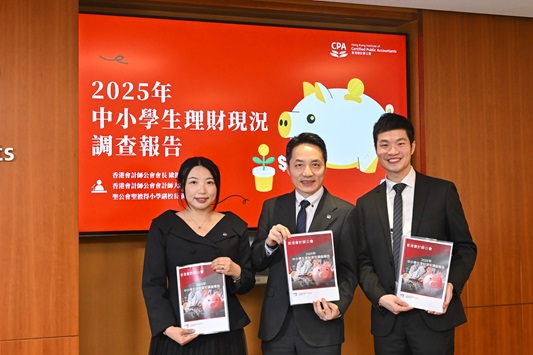
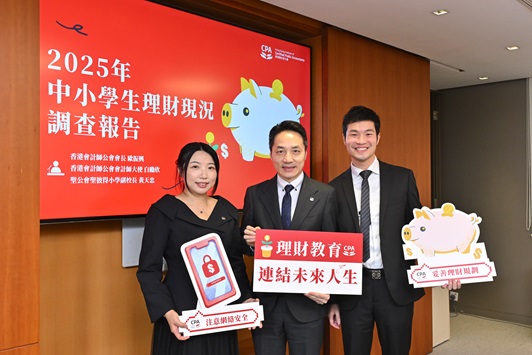
The Hong Kong Institute of Certified Public Accountants (HKICPA) published the "Teen Money Management Survey 2025", which graded the financial literacy of Hong Kong’s primary and secondary school students as "B-", reflecting that students generally possess basic financial knowledge. Meanwhile, there is an urgent need for students to enhance their cybersecurity awareness and cyber fraud prevention ability in an increasingly digital world.

The HKICPA President Edward Au said the Institute has been consistently promoting financial education for the youth through various initiatives. He believes that equipping the new generations with sound financial literacy and skills is fundamental for Hong Kong's future development.
